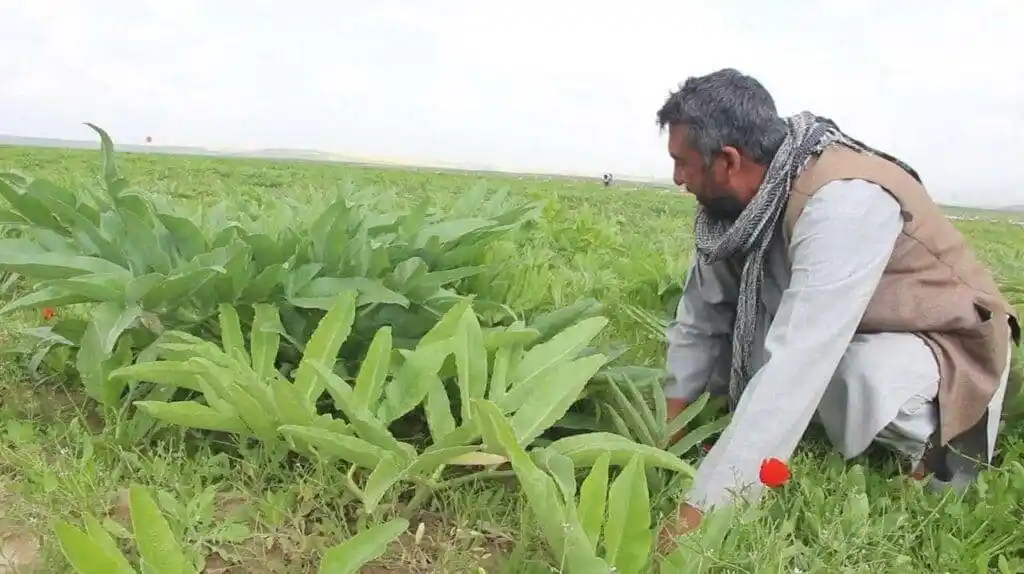
Afghan Henja Plant: Nature’s Hidden Treasure 🌿
Asafoetida (known as Anja, Hanj, or Heng in Persian) is one of Afghanistan’s finest natural and export-quality medicinal plants. In the past, it grew naturally in the northern and northeastern provinces of the country, but due to unprofessional harvesting, it gradually disappeared. However, since 2014 (1393 Hijri-Shamsi), its cultivation and resin production have significantly increased across Afghanistan.
In the provinces of Balkh, Baghlan, Samangan, and many other northern and northeastern regions, a large number of farmers have now turned to cultivating asafoetida.
The leaves of the asafoetida plant are herbaceous and green, measuring about 50 to 60 centimeters in length. Its stem is strong, tall, and fibrous, covered with hair-like structures, and has a cylindrical shape, reaching up to 2.5 meters in height. The root extends 12 centimeters downward and penetrates up to 40 centimeters deep into the soil. The horizontal growth of the roots near the soil surface helps protect and stabilize the soil in the areas where this plant is cultivated.
The resin of asafoetida is obtained by cutting the plant’s root or stem, from which the sap exudes; this resin is called Anja (Asafoetida). Asafoetida is a natural plant of Afghanistan. According to available statistics, wild medicinal asafoetida plants are found in Samangan, Herat, Baghlan, Badakhshan, Sar-e-Pol, Takhar, Kunduz, Balkh, Faryab, Badghis, Bamyan, Jawzjan, Farah, and Ghor provinces.
Asafoetida (Heng/Anja) has thick, fleshy roots. It grows in dry and warm regions of Asia, such as the arid deserts of Iran, the mountainous areas of Afghanistan, and India, and it produces yellow flowers. The fruit of this plant is oval-shaped and brown in color.
Afghanistan is a mountainous country with nearly five thousand different plant species, of which 25 to 30 percent are endemic to the country. Likewise, a wide variety of medicinal plants grow across Afghanistan and are traditionally used by the people to treat various illnesses.
Furthermore, a study has shown that 215 types of medicinal plants are used traditionally within the country. Among the most important medicinal plants are asafoetida (Heng/Anja), licorice, cumin, madder (ile rang), kakuti, spilanthes, basil, caraway, and longash.
Asafoetida is a plant that grows for several years as a herbaceous species and eventually produces a flowering stem, after which its life cycle comes to an end. Various types of asafoetida are found around the world. In Afghanistan, three natural types of asafoetida exist—red asafoetida, white asafoetida, and chair (chahar)—all of which are considered valuable export products of the country.
According to previous statistics from the Statistics Directorate of the Ministry of Agriculture, Irrigation, and Livestock, Afghanistan produced 2,549 metric tons of asafoetida (Heng) resin nationwide in the year 1398 (2019). India is the largest market for Afghanistan’s medicinal plants. Asafoetida is mainly cultivated in the provinces of Balkh, Takhar, Jawzjan, Samangan, and Badakhshan.
It was also planned that in the year 1400 (2021), a project aimed at enhancing the value and regulation of medicinal products—particularly asafoetida—would be implemented in the provinces of Balkh, Samangan, Kunduz, Takhar, Badakhshan, Jawzjan, Faryab, Sar-e-Pol, Herat, Badghis, Ghor, Paktia, Ghazni, Farah, and Logar.
Samangan
Samangan is a province with extensive rain-fed areas suitable for asafoetida cultivation. In this province, 19,702 hectares of land are cultivated with rain-fed asafoetida. Additionally, 89 hectares of irrigated land are also planted with asafoetida.
Last year alone, 700 hectares of rain-fed asafoetida fields were rehabilitated in Samangan, and agricultural packages—consisting of 15 items including asafoetida seeds—were distributed to 800 farmers involved in its cultivation. Meanwhile, farmers’ interest in growing and producing asafoetida continues to rise day by day. Government export programs to neighboring countries and India, as well as state-supported initiatives for expanding its cultivation and production, have also increased farmers’ motivation.
Balkh
The Agriculture, Irrigation, and Livestock Directorate of Balkh Province reports that asafoetida yields in the province are increasing year by year. forecasts indicate that the asafoetida cultivation area in the province is around 4,000 jeribs.
The amount of asafoetida resin produced per jerib varies depending on the characteristics and raw quality of the plant. Based on the condition of the crops, farmers can obtain 200 to 300 kilograms of asafoetida from each jerib. Furthermore, the area dedicated to asafoetida cultivation continues to expand each year, resulting in an increase in production levels.
The harvesting of the asafoetida plant usually begins in the autumn season. In Samangan province, asafoetida cultivation starts after the 15th of Aqrab (late autumn). Asafoetida can be cultivated both by seed broadcasting and transplanting seedlings.
According to the Director of Agriculture in Samangan, if the plant is grown from seeds, it takes four to five years to mature and produce resin. However, if transplanted seedlings are used, the plant begins producing resin after one year. These seedlings are obtained from small underground shoots.
In the spring, the asafoetida plant maintains its leaves, but later the leaves fall off. Once the leaves have shed, the harvesting season begins. The resin is collected by cutting the stem or the leaf base. The stem of the plant is thick, and after cutting, the resin that exudes is gathered once it has dried and hardened.
The first-grade asafoetida is sold at 85 USD per kilogram, while the second grade is sold at 70 USD per kilogram. He added that farmers’ interest in cultivating asafoetida has increased, and they now export their products directly to India, Pakistan, and the United Arab Emirates.